Learning with Joy and Independence
The Montessori Children’s House is a place where children aged 3 to 5 learn, explore, and grow with confidence.
Rooted in the educational philosophy of Maria Montessori, it sees each child as an active participant in their own development.
Guided by the principle “Help me do it myself,” daily life in the
Children’s House nurtures the child’s natural curiosity and desire to learn.

A Prepared Environment for Independent Discovery
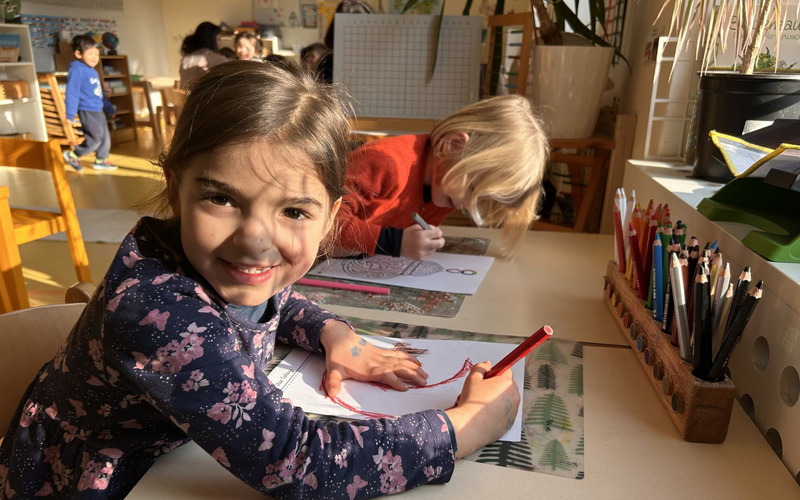
The Children’s House environment is carefully structured, calm, and aesthetically designed. Low shelves, child-sized furniture, and high-quality materials enable independent action and purposeful activity. Children:
- choose their work freely within a clear framework
- work at their own pace
- repeat activities to deepen understanding
- take responsibility for themselves and their community
Learning areas include practical life activities (such as pouring,
cutting, fastening), sensory materials, language development,
mathematics with concrete materials, and cosmic education — exploring nature, culture, and the interconnectedness of the
world.
The materials are sequenced thoughtfully, allowing knowledge and skills to build step by step through hands-on experience.
Learning Through Daily Experience
Learning in the Children’s House is holistic and active. Children develop early literacy and numeracy skills, refine fine and gross motor coordination, and strengthen social awareness and emotional resilience.
In mixed-age groups, cooperation, empathy, and responsibility grow naturally. The bilingual German–English environment supports language development organically throughout the day.

Growing in Confidence
Educators act as attentive guides. Through careful observation, they recognise each child’s developmental stage, offer purposeful impulses, and create an atmosphere of respect, calm, and
appreciation. Their role is not to direct learning, but to support and enrich it.
Clear routines, consistent guidance, and respectful relationships provide security and orientation. As children grow, they increasingly take responsibility for their work and their community, building concentration, perseverance, and genuine self-confidence.
The Montessori Children’s House offers children the space to unfold their personality, experience themselves as capable and effective, and develop joy in learning — a strong and stable foundation for their further educational journey.
A typical day in Children’s House
7:30–8:00
Early care in the movement room (Nido + Children’s House)
8:00–approx. 11:00
Group room with Montessori materials
(including morning snack and circle time)
11:00–12:00
Outdoor play area
12:00–approx. 13:30
Lunch and rest time
(including teeth brushing)
13:30–15:00
Group room with Montessori materials
(including afternoon snack and circle time)
15:00
First pick-up time
15:00–16:00
Outdoor area (flexible pick-up time)
16:00–17:00
Late care (subject to availability)
In addition
Once a week – Library
Once a week – Movement room (planned activity; otherwise spontaneous use)
1–4 times per month – Group excursion (approx. 3 hours)
Frequently Asked Questions Children’s House
Children joining from outside require the accompaniment of a parent for approximately three weeks before attending the full-day programme independently. The settling-in process is individually adapted to each child. A short separation from the parent is usually attempted on the second day, particularly for children who are already familiar with separation from their nursery experience.
Pacifiers and milk bottles should not be brought to the Children’s House and are not used by educators during the day. Ideally, these aids are also phased out at home, as this supports the child’s emotional and language development in the best possible way.
If toilet training has not yet been completed at the beginning of the settling-in period, we support each child individually and sensitively in close cooperation with parents until this developmental milestone is confidently achieved.
The high-quality Montessori materials comprehensively meet the evelopmental needs of children aged three to six, making conventional toys largely unnecessary. Activities from practical life, sensorial education, language, mathematics, nature, culture, music, art, and movement are integrated into daily life. Each child receives individual guidance through the presentation of materials suited to their age and stage of development.
Bilingualism is implemented through the immersion method, as in all areas of ibms. One educator speaks German and the other English. Children may speak the language of their choice. Errors are not explicitly corrected; instead, the focus is on encouraging confidence and joy in speaking, communicating, and expressing ideas. Materials are presented in both languages.
Choosing the right school is an important decision.
Our admissions team will be happy to support you personally.